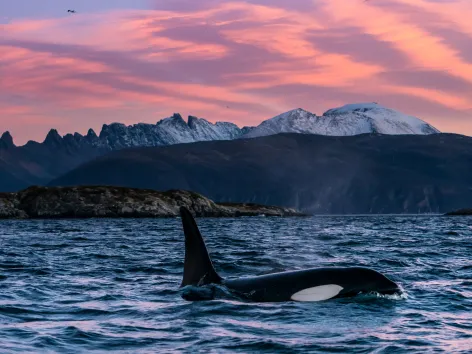
Experiencing whales in their natural habitat is a magnificent experience. In recent years, the fjords north of Tromsø, particularly around Skjervøy and Kvænangen, have been important feeding grounds for whales. During the winter, orcas and humpback whales gather in the area to feed on herring.
Several of Visit Tromsø’s activity providers offer whale-watching experiences of various durations and types. Many options start in Tromsø and last most of the day, either travelling by boat or combining transport by bus or minibus with a boat trip from Skjervøy.
Some guests choose to travel to Skjervøy independently and join a tour from there.
Orcas, humpback whales and other marine wildlife can be found in the fjords north of Tromsø during the season. You may be lucky enough to see whales from land, but joining a whale-watching tour gives you the opportunity to experience them out at sea. Sometimes, whales may even approach the boat on their own.
Whale sightings cannot be guaranteed. Our members follow whale-watching guidelines, keep a safe distance and aim to minimise disturbance. All encounters take place on the whales’ terms.
More than exotic wildlife
Wildlife is not the only impressive part of a whale-watching safari. You can also enjoy spectacular views that only Northern Norway can offer. The whale-watching season coincides with some of the darkest months of the year. The Polar Night in Tromsø lasts from around 27 November to 15 January, but this does not mean it is completely dark all day. Around midday, a few hours of twilight bring soft light and colour to the landscape.
It is hard to beat the sight of a whale’s fin against pink polar skies and snow-capped mountains.
Dust off your camera lens, dress warmly and join us for a nature-based experience!
Did you know?
Whales follow the herring. Some years ago, these marine mammals could often be seen just off the coast of Tromsø. Since 2017, orcas and humpback whales have gathered to feed on herring in the Kvænangen area, including the fjords around Skjervøy.
The herring can move to different areas from year to year, and the whales follow their food source. This means that both the location of the whales and the exact timing of the whale-watching season can vary.
 Tromsø